
Viltnämnden — usually written “Viltnemnda” in English text — is Sweden’s system of regional wildlife management delegations. Operating under the country’s county administrative boards, these bodies bring hunters, landowners, conservationists, and officials around the same table to handle the conflicts that inevitably arise where people and wildlife share the landscape: crop damage, livestock losses to predators, and hunting rules.
This guide explains what the viltnämnd actually is, what it does, who sits on it, and the laws behind it — based on how Sweden’s wildlife governance really works. For another glimpse of Swedish life, see our guide to bjudlunch, Sweden’s invited lunch tradition.
What the Viltnämnd Actually Is
Sweden manages wildlife at two levels. National policy — hunting seasons, protected species rules, large carnivore targets — is set by the Swedish Environmental Protection Agency (Naturvårdsverket) and the government. But the day-to-day friction happens locally: a farmer’s fields trampled by wild boar, a reindeer herder losing animals to lynx, a village arguing over a moose hunt.
That is where the viltnämnd comes in. Each county administrative board (länsstyrelse) has a wildlife management delegation that deals with regional wildlife issues — a forum where the competing interests meet, discuss, and decide within the framework of national law.
What It Does
The viltnemnda’s workload centers on a few practical areas:
- Wildlife damage. When prevention fails — fences, deterrents, guarding — the delegation handles the consequences: assessing damage claims and deciding on compensation or protective hunting.
- Protected species hunting permits. Some of its most visible and debated decisions concern permits to hunt otherwise protected animals, such as wolves or bears, when the specific conditions in law are met.
- Advisory and mediation. Beyond formal decisions, the viltnämnd serves as a standing forum for dialogue between groups that rarely agree — hunters, farmers, Sami reindeer herders, and conservationists.
- Monitoring input. Regional population data and field knowledge feed into the delegation’s work, keeping decisions grounded in what is actually happening on the ground.
Who Sits at the Table
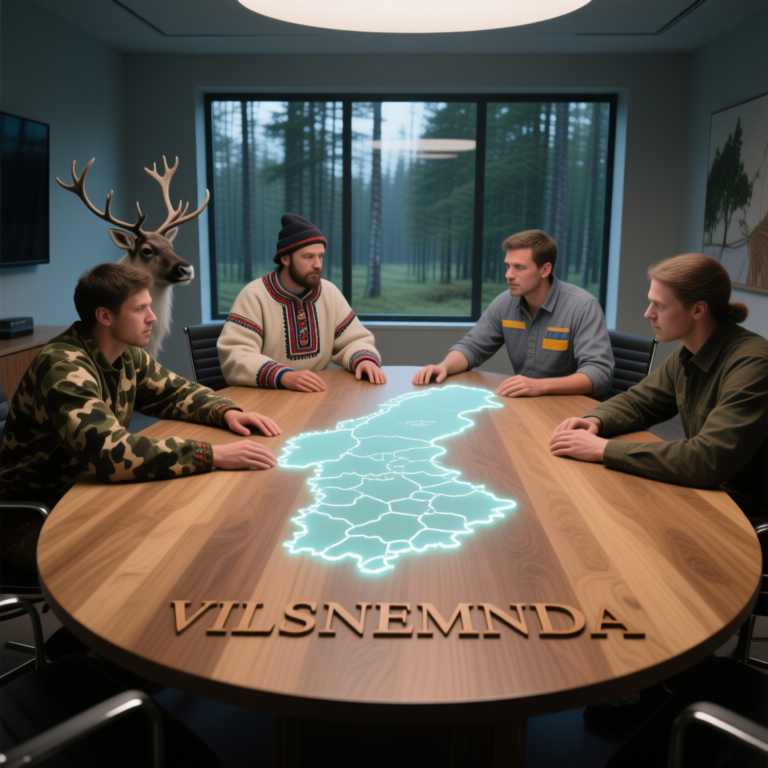
The point of the delegation is representation. A typical viltnämnd brings together:
- Landowners — who live with the costs of wildlife damage.
- Hunters — who contribute firsthand knowledge of animal populations.
- Sami village representatives — important in the north, where reindeer herding meets large predators.
- Environmental and animal welfare organisations — who speak for conservation interests.
- Other public interests — researchers, county officials, and community representatives.
This mix is deliberate: no single interest dominates, and every licensed hunt or compensation decision has been argued over by the people it affects most.
The Legal Framework
The viltnämnd does not invent its own powers. It operates under Swedish law — principally the Hunting Act (Jaktlagen, 1987:259) and the Environmental Code (Miljöbalken, 1998:808) — with national direction from the Environmental Protection Agency. Its decisions must fit inside that framework, and they can be appealed through the normal administrative channels.
Why Sweden Uses This System
Sweden is a long country with very different wildlife realities: wolves in the central forests, reindeer and wolverines in the far north, wild boar spreading in the south. A single national rulebook cannot handle that variation alone. The viltnemnda system pushes real decisions down to the regional level, where the people affected actually sit in the room.
It does not end conflict — nothing could — but it gives conflict a fixed address: a table, a schedule, and a legal framework, instead of open-ended disputes.
Common Misunderstandings
- It is not a court. The viltnämnd is an administrative delegation, not a judicial body. Its decisions follow administrative law and can be appealed.
- It is not national. Each county has its own delegation; there is no single “Viltnemnda of Sweden.”
- It cannot override the law. Protected species permits, for example, are only possible where the legal conditions are met — the delegation applies the rules, it does not rewrite them.
- “Innovative model” is marketing language. What is genuinely distinctive is the formal, regional, multi-interest structure — not a miracle cure for human-wildlife conflict.
Frequently Asked Questions
Is the viltnämnd a court?
No. It is an administrative delegation under the county administrative board. Its decisions are administrative decisions and can be appealed.
Does every Swedish county have one?
Wildlife management delegations are tied to the county administrative boards, so the structure exists across Sweden’s counties, with composition adapted to regional conditions — Sami representation matters most in the reindeer-herding north, for example.
Can its decisions be appealed?
Yes. As administrative decisions, they can be challenged through Sweden’s administrative appeal process.
The Bottom Line
The viltnemnda is not a famous institution, and it was never meant to be. It is a working piece of Swedish governance: a regional table where hunters, landowners, herders, and conservationists argue out the practical business of sharing land with wildlife — inside the law, and on the record. That unglamorous function is exactly why it matters.