

The “glow peptide” — usually sold under the name GLOW — isn’t a single ingredient. It’s a blend of three different peptides: GHK-Cu (a copper peptide with genuine skin research behind it), BPC-157, and TB-500 (both experimental compounds with almost no human data). It’s trending as an “inside-out” approach to skin rejuvenation, but here’s what most sellers won’t tell you: the science ranges from solid to nearly nonexistent depending on which ingredient you’re actually talking about. This guide breaks down each one honestly — what’s proven, what’s promising, and what’s pure marketing.
What Exactly Is the Glow Peptide Blend?
GLOW is a combination formula that packages three bioactive peptides into a single protocol, most commonly delivered by subcutaneous injection. There is no single standardized recipe — ratios vary between vendors, which is itself worth noting — but the typical blend contains:
| Peptide | Full name | Claimed role in the blend |
|---|---|---|
| GHK-Cu | Copper tripeptide-1 | Collagen production, skin repair, elasticity |
| BPC-157 | Body Protection Compound-157 | Tissue repair, inflammation control |
| TB-500 | Thymosin beta-4 fragment | Cell migration, healing support |
The pitch is synergy: each peptide supposedly covers a different angle of repair, so together they rejuvenate skin “from the inside out” in a way creams can’t. It’s a compelling story. Whether the evidence supports it is a different question — and it differs sharply for each ingredient.
Why Is It Suddenly Everywhere?
Three forces collided. First, the broader peptide boom in biohacking and longevity circles made injectable compounds feel mainstream. Second, med-spas and aesthetic clinics started offering GLOW as a premium skin treatment, giving it clinical-looking credibility. Third, social media did the rest — dramatic before-and-after posts travel fast, and “glow” is the kind of promise that sells itself. None of that is evidence, but it explains why you’re hearing about it now.
What Does the Science Actually Say?
This is where an honest guide has to split the blend apart, because lumping all three together is exactly how marketing hides the weak spots.
GHK-Cu: The One With Genuine Skin Research
GHK-Cu is a naturally occurring copper-binding peptide found in human plasma — and its levels decline as we age. Of the three, it’s the only one with a serious cosmetic research history. Scientists have studied it for decades, and topical GHK-Cu has human data behind it: supporting collagen synthesis, improving skin elasticity and firmness, and aiding wound healing. It’s a legitimate skincare ingredient, available in ordinary topical serums that don’t require a single injection. If any part of the GLOW blend earns its place in a skincare conversation, it’s this one.
For context on how well-studied skin ingredients compare, antioxidants like vitamin E have far deeper research files — our honest guide to what vitamin E actually does for skin shows what a properly evidence-backed ingredient looks like.
BPC-157: Strong Animal Data, Almost No Human Evidence
BPC-157 is a synthetic peptide derived from a protective protein found in the stomach. In rats and mice, the results are genuinely impressive — faster tendon, muscle, and gut healing across dozens of studies. But a 2025 systematic review tells the sobering story: of 36 studies screened, 35 were preclinical (animal or lab work) and only one involved humans. There are no completed randomized controlled human trials. It is not approved by the FDA — or any comparable regulator — for any condition, in any country. In July 2026, an FDA advisory committee voted 8–6 to recommend it for the compounding list, but that’s a non-binding recommendation, not an approval, and rulemaking hasn’t concluded. Promising? In animals, yes. Proven in people? No.
TB-500: The Thinnest File of the Three
TB-500 is a synthetic fragment of thymosin beta-4, a protein involved in cell movement and tissue repair. Its cosmetic case is mostly theoretical — extrapolated from how the parent protein behaves in lab settings. Direct evidence for skin benefits in humans is, by every serious account, limited and experimental. It’s also the ingredient that should make athletes pause: thymosin beta-4 and its derivatives are explicitly banned by the World Anti-Doping Agency, prohibited at all times in and out of competition. Like BPC-157, it has no FDA approval for any human use.
Injections vs. Serums: Why the Delivery Method Changes Everything
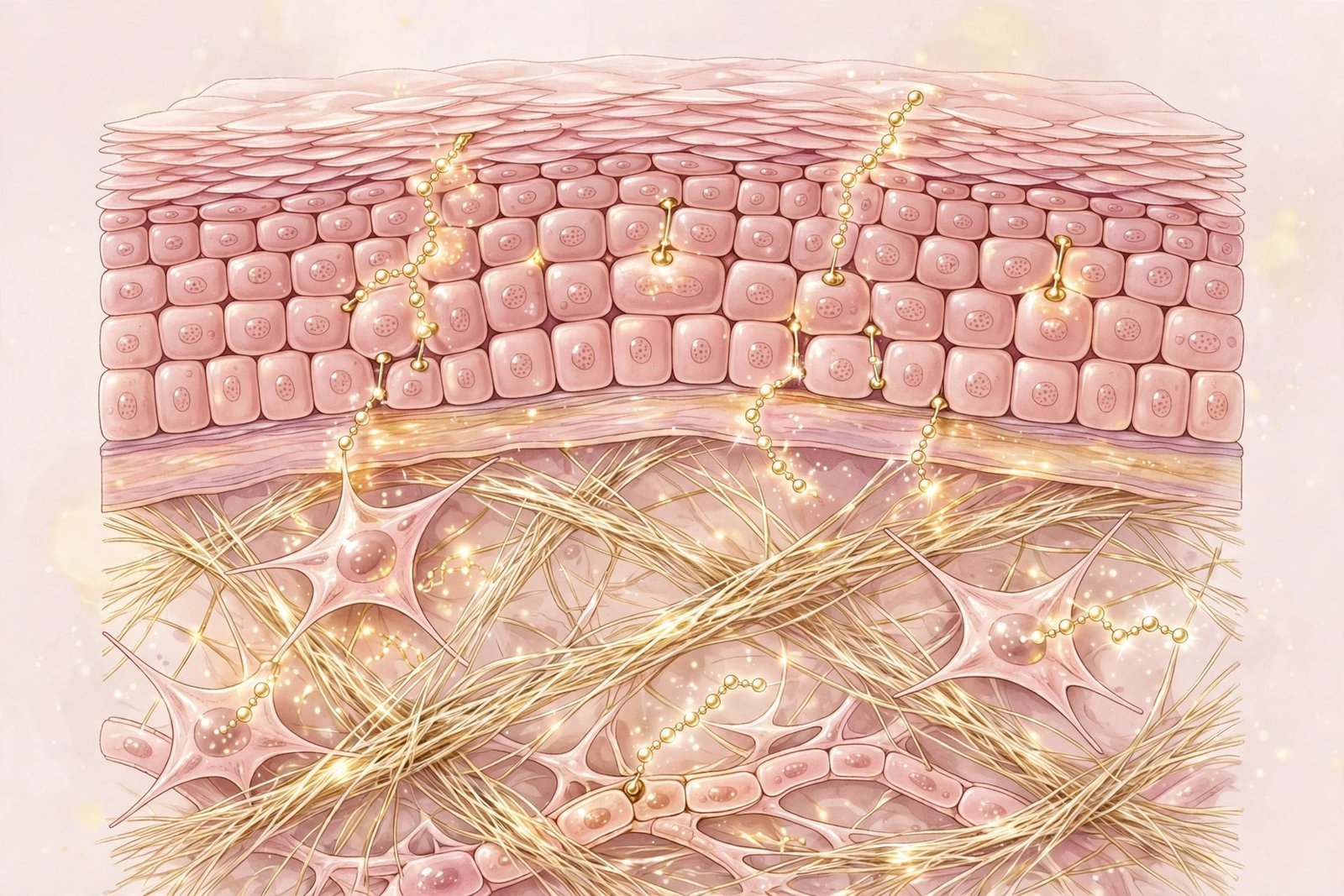
Marketing often blurs a critical distinction. A topical GHK-Cu serum is a cosmetic product: low risk, modest but real evidence, no needles, no systemic exposure. An injectable GLOW blend is a systemic protocol combining that cosmetic ingredient with two experimental research compounds — sold without standardization, quality oversight, or human safety data. These are completely different risk categories wearing the same trendy name. If someone sells you “glow peptides” without clarifying which version they mean, that’s your first red flag.
Peptides in skincare also work best as part of a consistent routine rather than a miracle single product — see how popular moisturizers actually compare before building yours around any one ingredient.
Claimed Benefits vs. What the Evidence Supports
| Claim | What the evidence actually shows |
|---|---|
| Boosts collagen production | Moderate — human studies support topical GHK-Cu; no human data for the injectable blend |
| Reduces fine lines and wrinkles | Limited to moderate — topical copper peptides only |
| Heals tissue faster | Animal studies only (BPC-157, TB-500) |
| “Glowing skin from within” | No controlled human trials for the injectable blend |
| Long-term anti-aging effects | No data exists |
Safety, Side Effects, and Red Flags
Let’s be direct about what isn’t known: there is no long-term human safety data for BPC-157 or TB-500 — no controlled data on drug interactions, effects in people with underlying conditions, or safe long-term exposure levels. What’s reported comes from anecdotes, not trials: injection-site irritation, headache, fatigue, and occasional nausea.
Then there’s the product quality problem. These compounds are sold as “research use only,” which means no regulatory oversight of purity, dosing accuracy, or contaminants. Independent testing of grey-market peptides has repeatedly found mislabeled vials. You’re trusting a vendor’s certificate — if they even provide one.
Red flags when evaluating any seller or clinic: guaranteed results, no mention of risks, medical advice from a sales page, pressure to buy “protocols,” and claims that it “works like Botox” or replaces dermatological treatments. If your skin is reactive, patch-test anything new first — our sensitive-skin cream comparison covers how to judge gentleness before you commit.
Who Should Stay Away
- Tested athletes — BPC-157 and TB-500 are WADA-prohibited at all times. A failed test doesn’t care about your intent.
- Pregnant or breastfeeding women, and anyone under 18 — no safety data whatsoever.
- People with a cancer history — these compounds influence cell growth and migration pathways; that’s a conversation for an oncologist, not a peptide vendor.
- Anyone on medication — interaction data doesn’t exist, so “probably fine” isn’t good enough.
5 Questions to Ask a Doctor Before Considering Any Peptide Protocol
- What exact compounds and doses are we discussing — and what human evidence supports them for my specific goal?
- What are the known risks, and what risks are simply unknown?
- How would we monitor for side effects, and what’s the exit plan if something goes wrong?
- What alternatives have better evidence? (Topical retinoids, GHK-Cu serums, and daily sunscreen are boring — and proven.)
- Is this legal where I live, and how is the product’s purity independently verified?
If a clinician can’t answer these clearly, that tells you everything you need to know.
GLOW vs. KLOW: What’s the Difference?
Shopping around, you’ll also run into KLOW — a four-peptide blend that takes the standard GLOW formula (GHK-Cu, BPC-157, TB-500) and adds a fourth ingredient, KPV, a small peptide fragment studied mainly in animals for inflammation-related pathways. Some sellers market KLOW as the “upgraded” version of GLOW.
The honest assessment doesn’t change: adding a fourth experimental ingredient to three others doesn’t create human evidence. There are no controlled trials of the KLOW blend either, and the same safety, quality-control, and legality caveats apply in full. Don’t pay a premium for extra ingredients with equally thin evidence files — more compounds means more unknowns, not more proof.
What Does GLOW Typically Cost?
There’s no standardized pricing, which tells you something about the market. Med-spas and wellness clinics typically sell GLOW as a premium treatment program — often bundled into multi-week “protocols” with consultations and follow-ups — while the same compounds sell far cheaper as “research use only” vials online. That price gap reflects clinical theater and markup, not verified quality: a higher price buys nicer rooms, not independently tested purity.
Practical advice: get an itemized breakdown before committing to anything, be skeptical of package deals that pressure you to decide on the spot, and remember that the only ingredient with real skin evidence — GHK-Cu — is available in topical serums at a fraction of the cost of any injectable program.
A Realistic Timeline: What to Expect From Glow Peptides
Search results are full of dramatic glow peptide before-and-after photos, so let’s set honest expectations. There are no controlled human trials of the injectable GLOW blend, which means nobody can legitimately promise you a timeline. What we can do is anchor expectations to the one ingredient with real data — topical GHK-Cu — and clearly flag what’s merely anecdote.
- Weeks 1–2: Expect nothing visible. The most commonly reported short-term effect is injection-site irritation, not radiance.
- Weeks 4–6: This is where anecdotal reports start claiming subtle changes — and roughly where early signals appear in topical copper-peptide research. Anecdotes aren’t data, but this is the earliest window where anything would plausibly show.
- Weeks 8–12: The standard measurement window in topical GHK-Cu studies. If the legitimate ingredient in the blend is going to visibly improve firmness or texture, this is the honest timeframe — for the serum, not the syringe.
- Beyond 12 weeks: Unknown territory. There is no human data on what months of the injectable blend do — for better or worse.
Treat online before-and-after photos accordingly: uncontrolled lighting, filters, makeup, and concurrent treatments explain most dramatic transformations. If someone’s “glow peptide results” appeared in two weeks, something other than peptides did the heavy lifting.
Frequently Asked Questions
Is the glow peptide FDA approved?
No. None of the three ingredients — GHK-Cu, BPC-157, or TB-500 — is FDA approved for therapeutic or cosmetic use. The 2026 FDA advisory vote on compounding was a recommendation, not an approval.
Is it legal to buy glow peptides?
They’re typically sold labeled “for research use only,” which is a regulatory gray area, not a safety endorsement. Legality for personal use varies by jurisdiction — verify yours rather than trusting a vendor.
How long until you see results?
There’s no honest human data to answer this for the injectable blend. Topical GHK-Cu studies typically run 8–12 weeks. Anyone promising faster results is selling, not informing.
Can athletes use glow peptides?
No — not if you compete in tested events. BPC-157 falls under WADA’s non-approved substances category and thymosin beta-4 derivatives are explicitly prohibited.
Does glow peptide help with fat loss?
There’s no evidence for that — none of the three ingredients is a weight-loss compound, and no human study links the GLOW blend to fat reduction. Some marketing borrows credibility from the GLP-1 weight-loss boom, but these are entirely unrelated compounds. Treat any fat-loss claim as marketing, not science.
How often do people inject glow peptides?
There is no standardized protocol — frequency and dosing vary between vendors and clinics, which is itself a red flag. We don’t publish dosing guidance for unapproved compounds with no human safety data. If a seller hands you a schedule without mentioning that uncertainty, they’re selling, not informing.
What’s the difference between NAD+ and glow peptide?
They’re different compounds riding the same longevity wave. NAD+ is a coenzyme involved in cellular energy metabolism; the GLOW blend is three tissue-repair peptides marketed for skin. Both are sold at med-spas with big promises and thin human evidence for their headline claims. Different mechanism, same skeptical lens.
Can you get the same skin benefits from a cream instead?
Partially — and that’s the interesting part. The only blend ingredient with genuine skin evidence, GHK-Cu, is widely available in topical serums with human research behind them. The other two ingredients have no proven skin benefits by any delivery method. So a well-chosen cream actually delivers the one proven piece of the blend without needles, systemic exposure, or gray-market sourcing.
What’s the safest way to get peptide benefits for skin?
Evidence-backed topicals (GHK-Cu serums, retinoids) plus daily sunscreen. Less exciting than an injection protocol — and actually supported by human research.
The Bottom Line
GHK-Cu is a legitimate cosmetic ingredient with real research behind it. BPC-157 and TB-500 are fascinating research compounds with strong animal data and no human proof. The GLOW blend wraps all three in marketing that runs well ahead of the science — selling the credibility of the one proven ingredient to carry two experimental ones. If glowing skin is the goal, the proven path still wins: protect with sunscreen, treat with evidence-backed topicals, and view injectable blends with the skepticism experimental medicine deserves.
This article is for informational purposes only and isn’t medical advice. Talk to a qualified healthcare professional before considering any peptide protocol.
Sources & Further Reading
The key studies and official references behind this guide:
- Pickart L, Margolina A. “Regenerative and Protective Actions of the GHK-Cu Peptide in the Light of the New Gene Data.” International Journal of Molecular Sciences. 2018. [PubMed]
- Vasireddi N, et al. “Emerging Use of BPC-157 in Orthopaedic Sports Medicine: A Systematic Review.” HSS Journal. 2025. [PubMed]
- World Anti-Doping Agency. “The Prohibited List.” [WADA]