

Quick answer: “Caricatronchi” is an Italian word from the forestry industry: it describes log-handling equipment such as log grapples (pinza caricatronchi) and wheel loaders fitted with grapple attachments (pala gommata caricatronchi). Since late 2025, the same word has also been used online as a catchy name for AI-generated caricature art. This guide explains both meanings honestly: the real industrial term, and how AI caricature generators actually work, which apps to try, and what to watch out for.
The Real Meaning: Caricatronchi in Forestry
In Italian, “caricatronchi” (from “caricare”, to load, and “tronchi”, logs) refers to machines and attachments built for lifting, sorting, and loading tree trunks. A “pinza caricatronchi” is a hydraulic log grapple mounted on an excavator or loader, with wide arm openings and continuous rotation for handling timber efficiently. A “pala gommata caricatronchi” is a heavy wheel loader equipped with one of these grapples instead of a standard bucket, commonly used in sawmills and large forestry operations. If you encountered the word on an Italian machinery listing, this is what it meant. Like other terms with more than one meaning, context decides everything: see our breakdown of what BR means in different fields for another example.
The New Internet Meaning: AI Caricature Art
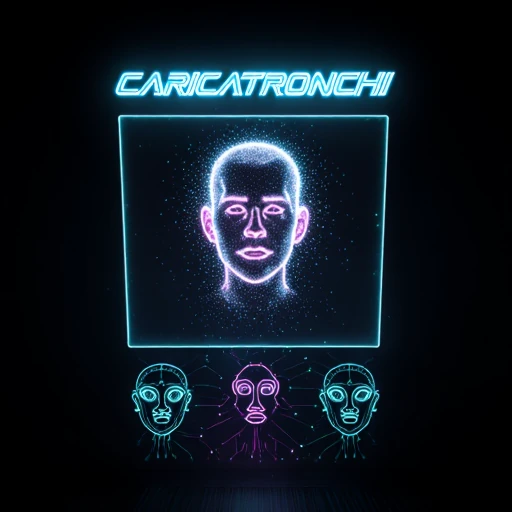
Separately, “caricatronchi” began circulating in late 2025 as a playful name for AI-powered caricature generators: apps and tools that turn an ordinary photo into an exaggerated cartoon portrait. There is no single official product behind the name. It is used loosely for a whole category of tools, much like “photoshopping” became a verb for image editing. Understanding the technology behind the category matters more than the label.
How AI Caricature Generators Actually Work
Modern AI caricature tools combine three technologies:
- Facial landmark detection. Computer vision first finds the face and maps key points: eye corners, nostrils, lip edges, jawline. This gives the software a geometric understanding of what makes your face yours.
- Exaggeration models. Convolutional neural networks trained on thousands of photo-and-caricature pairs learn how human artists exaggerate: which features get enlarged, which get minimized, and how far is too far. This is not a simple stretch filter; the model learns an artistic transformation.
- Image synthesis. Generative models (GANs and, more recently, diffusion models) render the final portrait in a chosen style, from cartoon to painterly, while preserving likeness.
Popular apps in this space include ToonMe, Voila AI Artist, and Prisma, which offer cartoon and caricature-style effects. These creative tools are part of a wider boom in AI tooling: see our guide to the best tech tools for developers for context on the platforms this generation of apps is built with.
Practical Uses for AI Caricatures
- Avatars and profile pictures: a distinctive cartoon version of yourself for social media.
- Gifts and keepsakes: personalized portraits for birthdays and events, at a fraction of the cost of a commissioned artist.
- Marketing and advertising: brands use stylized caricatures for campaigns and social content.
- Gaming: hyper-stylized player characters and streamer personas.
- Creative brainstorming: artists generate multiple exaggerated variants of a photo as starting points, then refine by hand.
AI vs. Human Caricaturists
Every new creative AI revives the same debate: does it cheapen human artistry? The honest answer is division of labor, not replacement. AI caricature tools win on speed, scale, and consistency: they can produce thousands of variations in the time a human artist draws one. Human caricaturists win on interpretation: a good artist reads personality, a nervous tic, a proud posture, a glimmer of mischief, and weaves it into the exaggeration. The machine does the commodity; the human does the masterpiece. Many working artists now use AI as an ideation partner, generating variants to refine rather than starting from a blank page.
Ethical Issues to Know About
- Consent: do not create caricatures of real people without their permission, especially unflattering ones. What is funny to you can be harassment to them.
- Bias in training data: models trained mostly on one demographic can produce offensive or stereotyped exaggerations of other ethnic features. Check results critically.
- Image ownership: read the app’s terms. You may grant broad licenses to photos you upload, and the legal status of AI-generated likenesses is still evolving.
- Deception: exaggerated images of real people can mislead. Label AI-generated portraits as AI-generated when sharing them.
Tips for Better AI Caricatures
- Use a clear, front-facing photo with even lighting. Sunglasses, heavy shadows, and extreme angles confuse landmark detection.
- Pick a style that suits the subject: comical exaggeration for humor, milder stylization for professional avatars.
- Generate several variants and compare. The first output is rarely the best.
- If the likeness is off, try a different photo before blaming the app. Input quality dominates output quality.
Frequently Asked Questions
What does caricatronchi mean?
In Italian, it is a forestry term for log-handling equipment such as log grapples and grapple-equipped wheel loaders. Online, it is also used informally for AI-generated caricature art.
Is caricatronchi a real AI software product?
No. There is no major official product called Caricatronchi. The word is used loosely online for AI caricature generator apps as a category.
Which apps make AI caricatures?
Popular options include ToonMe, Voila AI Artist, and Prisma for cartoon-style portraits, plus general AI image tools that accept caricature prompts. Features change quickly, so check recent reviews before paying for a subscription.
Can AI replace human caricature artists?
For high-volume, low-cost work, AI is already the practical choice. For interpretive, personalized pieces, human artists still lead. The most likely future is coexistence, with artists using AI for ideation.
Are AI caricature apps free?
Many offer free trials or basic styles, with fuller features behind subscriptions. Read the terms on photo rights before uploading personal images.
The Bottom Line
Caricatronchi wears two hats: a precise Italian term for forestry log-handlers, and a playful internet label for AI caricature art. Knowing which one you are dealing with saves confusion, and understanding how the AI tools actually work, facial mapping, learned exaggeration, and generative rendering, helps you use them well and ethically. The technology is impressive, but the artist’s eye, human or machine-assisted, still makes the difference.