
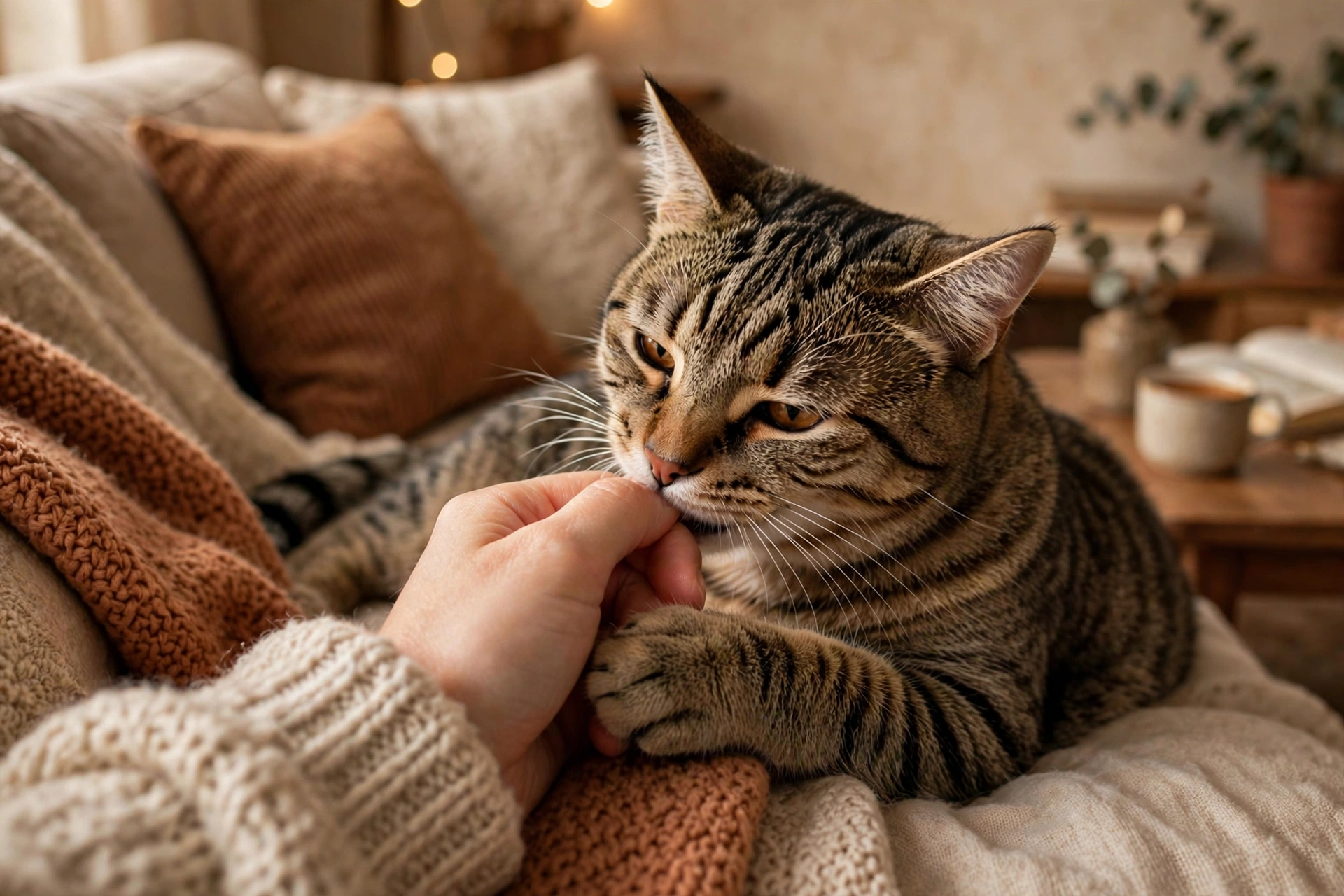

Your cat was purring on your lap, leaning into your hand, and then — suddenly — teeth on skin. Or the bite came during play, when your fingers became the most interesting moving object in the room. Or it happened in the hallway, with a quick nip at your ankle.
Most owners ask the same thing afterwards: why does a cat bite its owner when we feed, stroke and care for them? It feels personal, but for cats it is usually not aimed at you personally. A bite is communication. It can mean “too much,” “play with me,” “I’m scared,” or “that hurts.” Once you learn what your cat was saying just before the teeth appeared, you can respond in a way that keeps everyone calm and safe.
This guide covers the real reasons cats bite, the warning signs that come first, what to do in the moment, and how to reduce biting without punishment. It also explains when a sudden change needs a vet, and what to do if a bite breaks your skin.
Why does a cat bite its owner? The short answer
In healthy cats, biting an owner is usually normal behaviour at the wrong intensity or in the wrong context. The most common causes are playful hunting, overstimulation during petting, fear or stress, pain or illness, redirected frustration, and learned bids for attention or space. Kittens are still learning how hard is too hard.
Cats do not bite out of spite, revenge or bad character. When you identify the trigger that fits your situation, the remedy is usually straightforward: change the game, respect the early signal, rule out pain, and give your cat a better outlet for the same instinct.
The main reasons cats bite their owners
1. Play aggression: you looked like prey
Play and hunting use the same sequence: stalk, chase, pounce, grab, kick and bite. Indoors that sequence needs a target. If hands wiggle under a duvet, dangle from a sofa or move like toys, a young or bored cat will treat them as prey.
Play bites often come with dilated pupils, a crouch and wiggle, then a rush forward and a sprint away. Cats separated from their litter very early, or always played with using hands, are more likely to keep the habit. It is practice, not personal aggression.
2. Petting-induced (overstimulation) biting
This is the most confusing bite: your cat asks for a fuss, purrs, then suddenly turns and bites the stroking hand. Some cats enjoy petting for a long time; others have a low threshold, especially on the belly, lower back, tail base or legs. Repeated strokes in one spot can tip from pleasant to irritating in seconds. The bite is simply the fastest way to make it stop. Short cheek or chin strokes, with pauses to see if your cat leans in for more, prevent most of these incidents.
3. Fear, stress or feeling trapped
A frightened cat prefers to flee or hide. Biting appears when escape is blocked: being held too tightly, cornered by a child or dog, startled awake, or reached for quickly by a stranger. Look for flattened ears, a low or puffed-up body, hissing or growling, and attempts to back away. If biting only happens in one stressful context, such as the carrier appearing or visitors arriving, fear is the likely cause.
4. Pain or illness
Pain makes any cat quicker to bite, and cats hide pain well. A cat who suddenly objects to touch on the mouth, back, hips or belly may be guarding a sore area. Dental disease, arthritis, ear or skin problems, and unseen injuries are frequent culprits. A normally tolerant cat who starts biting, hides more, eats less, grooms less or struggles to jump needs a vet check, not training.
5. Redirected aggression
Sometimes the trigger has nothing to do with you. A cat wound up by another cat outside the window may turn and bite the hand that reaches in. If you see fixed staring, a flicking tail and loud calling at the glass, do not try to stroke your cat calm. Step back, block the view if you can, and wait until the body softens before you interact again.
6. Communication and attention
Some cats learn that a soft nip gets eye contact, food or play. Others bite to end interaction — to be put down or to move a hand. Attention bites are often gentle, delivered while looking at you, sometimes followed by leading you towards a bowl or toy. They should still be redirected, because teeth should never become the household language, but they tell you your cat needs a clearer way to ask.
7. Love bites vs. real aggression
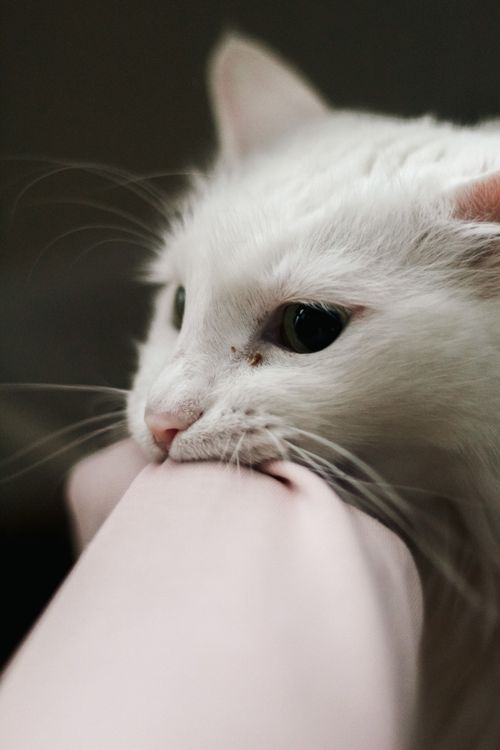
Many owners describe “love bites”: a cat lightly holds a hand or arm in its mouth during affection, without breaking skin, while purring and staying relaxed. This is social mouthing rather than aggression. The contrast is clear:
- More like a love bite: soft pressure, no skin break, relaxed ears, slow blinks, cat stays close.
- More like aggression: hard bite, possible skin break, ears back, dilated pupils, growl or hiss, tense body, cat tries to flee or keeps attacking.
Even affectionate nibbles are best redirected to a toy. If gentle mouthing is gradually getting harder, intervene early.
8. Kittens still learning
Kittens learn bite pressure from their mother and littermates: bite too hard and play stops. Kittens removed too early may miss that lesson, and single kittens often direct all play energy at owners. You can teach the same rule kindly: if teeth touch skin, go still, say a calm “ow,” withdraw for 20–30 seconds, then restart with a toy. Everyone in the home must be consistent. Knowing their age helps here too — if you are unsure, working out your kitten’s age can explain a lot about this playful, bitey stage.
Warning signs a bite is coming
Cats usually warn first, but their signals are subtle. Look for a cluster, not a single sign:
- Tail: rapid lashing, puffing, or sharp tip-twitching.
- Ears: flicking, rotating back or flattening.
- Skin: rippling or twitching along the back during stroking.
- Eyes: sudden pupil dilation, hard stare, or tense avoidance.
- Voice and body: growl, hiss, freezing, crouching, leaning away, or a quick head turn towards your hand. Going very still can be the final warning.
If you see two or three signs together, stop, withdraw your hand slowly and let your cat choose to stay or leave. Respecting that early “no” teaches your cat that teeth are unnecessary — which is exactly the lesson you want.
What to do when your cat bites
Try not to yank your hand away; pulling triggers the grab reflex and can deepen a bite. Instead:
- Go still and quiet. Relax your hand and avoid shouting.
- Wait for release. Most cats let go in seconds when “prey” stops moving.
- Withdraw attention briefly — stand, turn away or leave for 30 seconds. Biting ends the interaction.
- Restart later with a toy, not with petting or an immediate treat.
Never hit, spray or chase a cat after a bite. Punishment raises fear and makes future bites more likely. The Cornell Feline Health Center’s guidance on feline behaviour problems and aggression gives the same advice: find and change the trigger rather than confronting the cat.
How to reduce biting for good
Give hunting a proper outlet
Two or three short play sessions a day (5–15 minutes) with a wand or kick toy meet the need that drives most play biting. Let your cat stalk, chase, catch and “win,” then offer a small meal. Hunt, catch, eat, groom, sleep leaves a satisfied cat — and far fewer ankle ambushes. Rotate toys, store wand toys safely, and add a pre-bed session if nights are the problem.
Redirect every time
Keep a toy within reach where biting usually happens. At the pre-bite stare or wiggle, toss the toy before teeth make contact. If teeth do touch skin, go still, withdraw, and only then offer the toy. The rule must be identical for everyone; one person wrestling with hands will undo the training.
Pet on your cat’s terms
Let your cat start the interaction. Offer a hand to sniff, stroke cheek or chin briefly, then pause. Avoid the belly even when it is shown; for many cats that is trust, not invitation. Keep sessions short for sensitive cats and stop at the first tail flick. Teach children the same “stroke, pause, check” routine.
Calm the environment
Boredom and stress fuel biting. Provide scratching posts near rest areas, vertical space, hiding spots and quiet litter trays (one per cat plus one extra is the standard guideline). Keep routines predictable. If biting began with a house move, new pet or building work, increase play and safe retreats while things settle, and ask your vet about anxiety support if needed.
When biting means a vet visit
Book a prompt vet appointment if:
- A gentle cat suddenly starts biting, hissing or hiding.
- Biting centres on one area, or your cat flinches or cries when it is touched.
- Biting comes with appetite or weight change, vomiting, diarrhoea, drinking or urinating more, bad breath, limping, reduced jumping, or grooming changes.
- Biting is frequent, intense, or continues despite two to three weeks of consistent play and handling changes.
Your vet will check teeth, joints, ears and skin and ask what changed at home. If health is clear and biting persists, referral to a qualified behaviourist is a sensible next step.
If a bite breaks your skin
Cat teeth can push bacteria deep under the skin. Wash a bite straight away under running water with soap, let it bleed briefly to help flush the wound, then cover it with a clean dressing.
Watch the area over the next day. Seek same-day medical advice for spreading redness, swelling, warmth, increasing pain, red lines, pus, fever or stiffness. Seek urgent care for deep punctures, bites to the face, hands or joints, a bite from an unknown or unvaccinated cat, or if you have diabetes, low immunity or unsure tetanus cover. Say it was a cat bite. This is general information, not advice for your injury.
What not to do
- Do not play with hands or feet, even with kittens.
- Do not punish, shout at or physically discipline a cat for biting.
- Do not pull sharply during a bite or force handling to “build tolerance.”
- Do not ignore a sudden change — rule out pain first.
FAQs
Why does my cat bite me gently then lick me?
Light biting followed by licking is usually affectionate grooming or mild overstimulation. Pause stroking and offer a toy or a break. If pressure increases over time, redirect as you would any bite.
Why does my cat bite me for no reason?
There is almost always a reason from the cat’s view: moving feet, a need for play, or an attention bid. Regular play plus consistent redirection solves most cases. Truly unprovoked, repeated biting that is new for your cat warrants a vet check for pain or anxiety.
Why does my cat bite my ankles?
Ankles move like prey at cat height, especially in hallways. Increase interactive play, leave puzzle feeders out, and freeze rather than run when ambushed — then toss a toy ahead to redirect.
Should I worry about sudden biting?
A single bite with a clear trigger is usually manageable at home. Repeated sudden aggression, particularly in an older cat or with appetite, grooming or mobility changes, should always be checked by a vet.
Will my cat grow out of biting?
Kittens often improve as they learn bite control, provided feedback is consistent. Adult play biting needs an alternative outlet; without one it rarely fades on its own. With daily toy play and clear boundaries, most cats improve within weeks.
Bottom line
A cat who bites its owner is communicating a need: to play, to pause, to feel safe or to be comfortable. Read the early signals, keep hands out of the game, build a satisfying play routine, and check for pain promptly when behaviour changes. Do that consistently and biting usually gives way to the chosen contact — head-butts, slow blinks and relaxed company — that tells you your cat feels understood.
You will find more everyday care ideas in our Pet Care guides.