


Short answer: To tell a kitten’s age, check the eyes and ears first, then the teeth, weight and movement. Closed eyes with folded ears and an umbilical cord means days old. Eyes open and blue with the first tiny teeth means about three weeks. A full set of sharp baby teeth, steady running and play means roughly six weeks. When adult teeth start replacing baby teeth, the kitten is usually three months or older. No single sign gives an exact birthday, but together they usually place a young kitten within a week or two for most healthy kittens.
Age decides whether a kitten still needs milk, how often it should feed, whether it can keep itself warm, when to start litter training, and when to book vaccinations and neutering. A kitten that looks similar in size to another can need very different care if it is two weeks younger, so it is worth checking more than size alone.
How to Tell Kitten Age in Five Checks
Work through these checks in this order. They take only a minute or two, and the order helps because the earliest signs narrow the age before weight, which is the least reliable guide, has a chance to mislead you.
- Eyes. Are they sealed, just opening, fully open and blue, or starting to change colour? Kittens are born with closed eyes. The eyes usually begin to open at about 7 to 10 days and start blue in every kitten.
- Ears. Newborn ears lie folded flat against the head. They loosen in the second week, lift during the third, and normally stand upright by about four weeks.
- Belly. A fresh umbilical cord, or the small scab left after it falls off, means the kitten is only a few days old. The cord usually dries and drops off at around three to five days.
- Teeth. Gently lift one side of the lip; do not force the jaw open. Front teeth appear first, then the pointed canines, then the side premolars. Teeth follow one of the steadiest timelines of all.
- Weight and movement. Weigh the kitten on a kitchen scale lined with a cloth, then watch how it moves: paddling, crawling, wobbling, walking, or running and pouncing. Use both as a cross-check, not as the whole answer.
Kitten Age Chart: Eyes, Teeth, Weight and Movement by Week
This chart is a guide to how to tell kitten age for a healthy, well-fed kitten. Breed, litter size, illness and poor feeding can move the weight figures a lot, so read the chart as a range and confirm it with teeth and eyes.
| Age | Eyes and ears | Teeth | Typical weight | Movement and feeding |
|---|---|---|---|---|
| Birth to 1 week | Eyes closed; ears folded; cord present, then a small scab | None | About 90 to 150g | Sleeps most of the time; weak paddling crawl; milk only |
| 1 to 2 weeks | Eyes opening, cloudy blue; ears still folded | None visible | About 150 to 250g | Stronger crawling; vision is blurry; milk only |
| 2 to 3 weeks | Eyes fully open and blue; ears beginning to lift | Tiny front incisors appear | About 250 to 350g | First standing and wobbly steps; notices littermates |
| 3 to 4 weeks | Ears mostly upright; eyes still blue | Pointed canines appear | About 350 to 450g | Walks with a wobble; first play; weaning can begin |
| 4 to 5 weeks | Ears upright; eye colour may start to change | Premolars appear at the sides | About 450 to 550g | Pounces and explores; lapping and tasting solid food |
| 5 to 6 weeks | Eye colour change under way in many kittens | Full set of 26 baby teeth in most kittens | About 550 to 650g | Runs, climbs and wrestles; eating more solid food |
| 6 to 8 weeks | Eyes close to adult colour | Baby teeth complete and needle-sharp | About 650 to 900g | Coordinated play; grooms itself; uses a litter tray |
| 8 to 12 weeks | Adult eye colour mostly settled | Baby teeth still in place | About 900g to 1.4kg | Confident and curious; first vaccinations are due |
| 3 to 6 months | Looks like a small cat rather than a baby | Adult teeth replace baby teeth; 30 in total by about 6 months | Often about 1.5 to 3kg | High energy; teething; neutering is usually discussed |
Week by Week From Birth to Eight Weeks
Birth to one week: sealed eyes and an umbilical cord
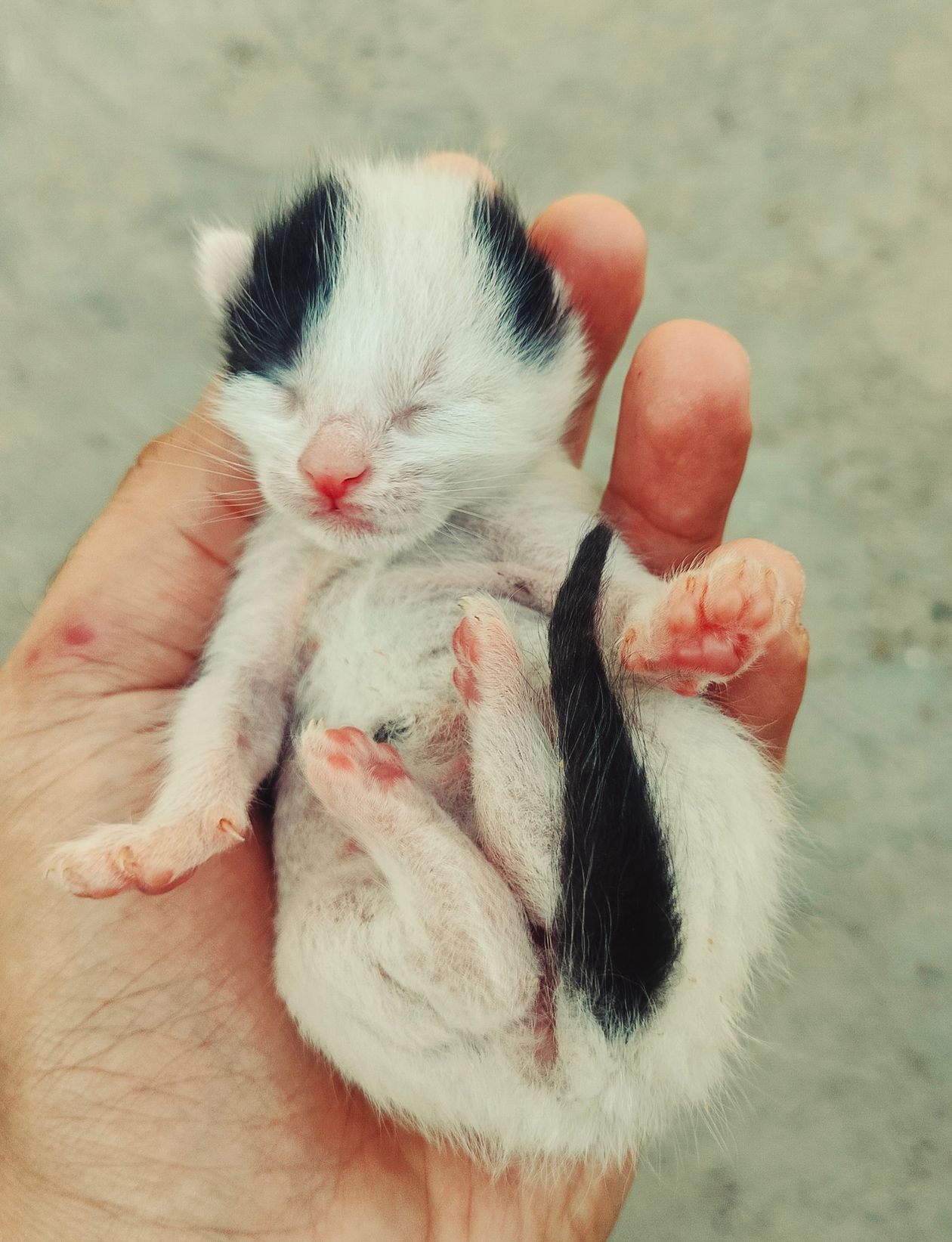
The eyes are sealed shut, the ear flaps are folded flat, and a short cord is attached to the belly for the first few days. Birth weight is usually around 90 to 110 grams, although well-fed kittens from small litters can be heavier.
Newborns sleep almost all the time, feed often, and move with a slow paddling crawl towards warmth. They cannot regulate their own body temperature and cannot go to the toilet without stimulation from their mother, so a kitten this young that is cold or alone needs urgent help. Never try to open closed eyes by hand.
One to two weeks: eyes begin to open
Between about 7 and 10 days the eyelids start to part, often with one eye opening slightly before the other. The eyes look cloudy blue and the kitten sees light and movement rather than detail. All kittens start with blue eyes, so blue on its own means young, not a breed or a final colour.
There should still be no visible teeth, the ears stay mostly folded, and weight often reaches about 150 to 250 grams by the end of the second week if feeding is going well.
Two to three weeks: first teeth and first steps
At around three weeks the change is obvious. The eyes are fully open, the ears unfold and start to stand, and the first teeth arrive: the small front incisors, usually from about two to three weeks. The kitten can stand, although the legs tremble, and it takes its first deliberate steps. Hearing improves, littermates become interesting, and play starts as clumsy swatting. Handle a kitten of this age briefly and gently, and keep checks of the mouth to one quick look.
Three to four weeks: canines, walking and the start of weaning
By four weeks most kittens walk with a wobble, leave the bedding for short exploring trips, and react to sounds. The pointed canine teeth usually come through at about three to four weeks, after the incisors and before the side premolars.
This is also the stage to introduce first tastes: a shallow dish of water, soft mashed kitten food, and chances to lap rather than only suckle. A low-sided litter tray with non-clumping litter can go nearby now, because many kittens start to toilet on their own at around three weeks.
Four to six weeks: premolars, proper play and more solid food
Between four and six weeks the mouth fills in from the sides as the premolars erupt, bringing the baby set to 26 teeth. Movement changes just as much: pouncing, chasing, climbing and wrestling replace wobbling.
Eye colour often starts shifting away from the starter blue towards green, amber or gold, or stays blue in breeds where that is normal. Weaning moves forward too, with several small solid meals a day, although many kittens still take milk from their mother when she is present.
Six to eight weeks: coordinated, grooming and eating solids
A six- to eight-week-old looks like a miniature cat in motion. It runs in short athletic bursts, grooms itself, uses the litter tray more reliably, and eats solid food without help. The baby teeth are complete and very sharp, and adult eye colour is usually clear or nearly settled.
In the UK, responsible rescues and breeders keep kittens with their mother and littermates until at least eight weeks, and many wait until 12 weeks or more because those weeks teach social skills and bite control that are hard to replace later.
Teeth: From First Baby Teeth to a Full Adult Set
Teeth are often the best guide to how to tell kitten age between three weeks and six months because they erupt in a set order that food and body size do not change. You rarely need a long look: a calm kitten, one lip lifted at the side, shows the front and canine teeth that tell you most of the story.
Baby teeth: two to six weeks
- About 2 to 3 weeks: the small front incisors appear.
- About 3 to 4 weeks: the four pointed canines come through.
- About 4 to 6 weeks: the premolars erupt at the sides, completing 26 baby teeth.
Baby teeth are smaller, whiter and sharper than adult teeth. Kittens have no big chewing molars at the back, so a neat row of tiny teeth with no large back teeth usually means a kitten under about three months.
Adult teeth: three to six months
From about three to four months, baby teeth fall out and adult teeth take their place. The adult incisors usually come first, the canines follow at around four to five months, then premolars and finally the molars, which have no baby version. Most cats have the full adult set of 30 teeth by about six months.
A mixed mouth of loose baby teeth and bigger adult teeth therefore points to roughly three to five months. If a baby canine stays in place beside the new adult canine, a vet should check it, because retained baby teeth can trap food and crowd the adult tooth.
Weight: Using the 100-Gram-a-Week Guide Without Being Misled
A useful rough guide is that many kittens weigh about 100 grams at birth and gain about 100 grams a week in the first weeks, so about 300 grams suggests roughly three weeks and 500 grams roughly five weeks. A kitchen scale, a soft cloth for grip, and weighing at a similar time each day give you a growth record as well as an age clue. A healthy young kitten usually gains steadily, often around 10 to 15 grams a day in the early weeks.
When you are learning how to tell kitten age, treat that rule as a cross-check, never as proof. An orphaned, stray or unwell kitten can be far lighter than its age, while a large breed can be heavier from the start. One weighing can also be thrown by a recent feed.
The pattern matters more. Steady daily gains are reassuring, while weight loss, no gain for several days, constant crying, or a kitten that feels cold or limp needs prompt veterinary help. After eight weeks, many average kittens gain roughly 400 to 500 grams a month, which is why a typical 2-kilogram kitten is often about four to five months old. Always compare that figure with the teeth before you decide.
Older Kittens: Estimating Age From Two to Six Months
After two months the weekly changes slow down, so teeth and body shape do more of the work than eyes. At eight to 12 weeks the baby teeth are still in place and eye colour is mostly settled. From three months, look for adult teeth arriving, a longer body, and a less round face.
By four to five months many kittens are teething, very active, and around 2 kilograms if they have been well fed. Play biting is common at this stage, so if it is becoming a habit, our guide to why a cat bites its owner explains the usual reasons and safer ways to play. By six months most cats look like slim young cats and have, or are close to, their full adult teeth.
When the Signs Point to Different Ages
Real kittens do not always match the chart in every row. You might find six-week teeth on a kitten that weighs only 450 grams, or a small kitten that already runs confidently. When that happens, trust the teeth and eyes first, movement second, and weight last. Teeth change on a schedule; weight changes quickly when food has been scarce.
Runts, premature kittens and kittens recovering from illness often look a week or two younger than they are. Until a vet confirms the age, care for the kitten at the younger end of your estimate, because extra warmth and suitable soft food are safer than assuming it is older.
Found a Kitten Outside? Do This Before You Move It
Knowing how to tell kitten age helps you decide what to do first. If you find young kittens outdoors, their mother may be hunting or waiting nearby for you to leave. If the kittens look clean and settled and are not in immediate danger, watch from a good distance for a couple of hours before deciding they are abandoned. A mother cat usually returns quietly when people are gone, and kittens raised by their mother almost always do better than hand-reared kittens.
Act sooner if newborns are cold, crying constantly in the same place, injured, or their mother has not returned after several hours. Keep very young kittens warm and contact a vet or local rescue before you feed them.
Do not give cow’s milk: many cats cannot digest lactose well, and diarrhoea can become dangerous quickly in a tiny kitten. Kitten milk replacer is the suitable substitute, and only when feeding is advised for the kitten’s age and condition.
When a Vet Should Confirm the Age
Book a vet visit within the first few days of bringing a kitten home, and sooner if it is under three weeks old, cold, limp, not feeding, losing weight, or has diarrhoea. At that visit the vet can confirm your age estimate from the teeth, eyes, weight and body condition, and check for fleas, worms and ear mites.
Age also sets the timetable for vaccinations, which usually start at about eight to nine weeks in the UK, plus microchipping and neutering, commonly discussed from around four months. The ASPCA guide to newborn kitten care is a helpful reference for the earliest stage, but it does not replace a hands-on examination. If you want more background reading after that appointment, browse our Pet Care guides.
Frequently Asked Questions
How can I tell how old a kitten is?
Combine the eyes, ears, teeth, weight and movement. Closed eyes and folded ears mean under two weeks; open blue eyes with first incisors point to about three weeks; a full set of 26 baby teeth with confident play suggests about six weeks; adult teeth replacing baby teeth mean about three months or more.
How do I tell a kitten’s age from its teeth?
Front incisors appear at about two to three weeks, canines at three to four weeks, and premolars at four to six weeks, completing 26 baby teeth. From about three months adult teeth replace them, and most cats have all 30 adult teeth by around six months.
How old is a kitten that weighs 2kg?
Usually about four to five months, if the kitten has been growing normally. Large breeds may reach 2kg sooner and underfed kittens later, so confirm it by checking whether adult teeth are coming through.
Can I estimate a kitten’s age from weight alone?
Only roughly. About 100 grams at birth plus roughly 100 grams a week works for many healthy kittens in the first two months, but illness, litter size, breed and missed meals can move the result by weeks. Use weight last, after teeth and eyes.
Is a four-month-old still a kitten?
Yes. Cats are generally treated as kittens until about 12 months old. At four months a kitten is usually teething, growing fast and highly active, and it is a good time to discuss neutering and vaccination status with your vet.
Can a vet tell exactly how old my kitten is?
A vet can usually give a close estimate, often within about a week for a young kitten and within a few weeks for an older one. Without a known birth date, no examination can give an exact birthday.