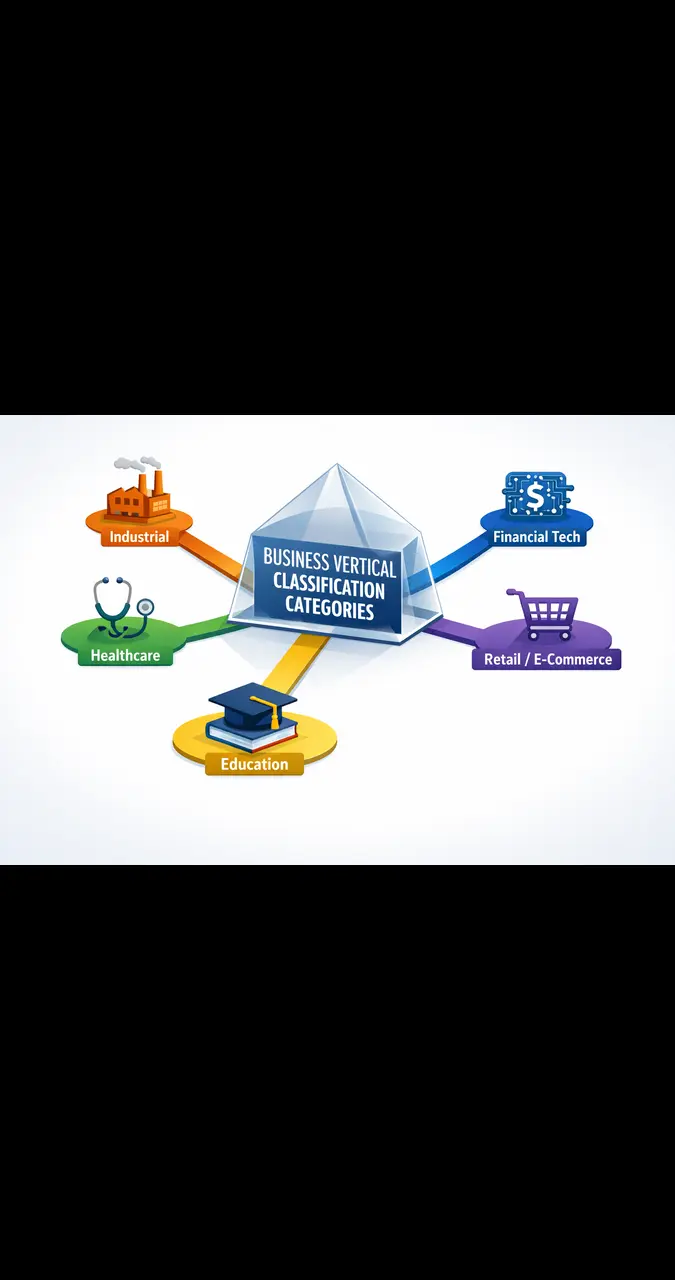
business vertical classification categories
As the business world becomes more complex and ever-changing, it becomes even more important to optimise and structure an enterprise for operational efficiency, market focus, and strategic clarity. This is the point at which the Business Vertical Classification Categories framework becomes invaluable to leaders, strategists, and analysts. This Business Vertical Classification Categories framework helps structure a company’s operations, offerings, and markets systematically to drive value and operational growth, support effective resource allocation, and sustain a sustainable competitive advantage. This article will examine the essence of business vertical classification, its primary categories, core strategic value, and practical application potential.
Business Verticals: What Lies Beyond The Silos
A business vertical is a business that focuses on a specific market or sector in which a company operates, offering a defined, integrated line of products and services to a target-specific clientele. Unlike horizontal functions (for example, HR or IT), which serve the entire organisation, verticals are self–contained units with their own dedicated resources, a self-sufficient management structure, and profit & loss (P&L) responsibility.
Business vertical classification organizes defined verticals to give a strategic view of a company’s market position. This classification is unique to each company and varies by size, industry, and strategy, often fitting into a few broad categories.
Leading Entrepreneurial Vertical Classification Types
There are several ways to classify business verticals. Here are the most common methods.
1. Vertical Classification Based On Market or Industry
This is the most common business vertical classification, in which verticals are defined by the market or industry they serve. Verticals also require significant specialization in the industry’s domain-specific concerns, such as regulations, challenges, and opportunities.
Examples: Healthcare Vertical, Financial Vertical, Retail & E-commerce Vertical, Manufacturing & Industrial Vertical, Government & Public Sector Vertical, Telecommunications Vertical.
Strategic Focus: Enables teams to develop deep industry expertise, tailor solutions to client needs, and create targeted marketing and product strategies based on specific market requirements.
2. Vertical Classification Based On Specific Product or Service Line
Here, classification centers around the core offering. This is common among enterprises with broad product ranges and separate brands or technology stacks.
Examples: Software Solutions Vertical, Hardware & Infrastructure Vertical, Consulting Services Vertical, Consumer Products Vertical, Cloud Services Vertical.
Strategic Value: Drives focused innovation within the product area, channels resources effectively into R&D, and enhances brand visibility and market recognition for the specific offering.
3. Customer Segment Verticals
This method sorts verticals by end customer, focusing on demographic, behavioral, or needs-based segments.
Enterprise/B2B, Small & Medium Business (SMB), Consumer/B2C, Education (schools and universities).
Strategic Value: Tailors all aspects of sales, service, and support to meet the unique preferences and requirements of each customer group, improving customer loyalty and engagement.
4. Geographic or Regional Verticals
For global or national players, verticals are typically organized by geography to account for local market sensitivities.
North America, Latin America, EMEA (Europe, the Middle East, and Africa), and Asia-Pacific (APAC) Verticals.
Strategic Value: Ensures solutions are adapted to local regulations, cultural expectations, logistics needs, and regional market competition, increasing relevance and effectiveness.
5. Channel-Based Verticals
This categorization is based on how customers access products or services, via market-access routes or sales channels.
Direct Sales, Partner & Reseller, Online/Digital, and Retail Distribution Verticals.
Strategic Value: Optimizes distribution methods, strengthens partnerships, and reduces conflicts between different sales channels to maximize market reach and efficiency.
In reality, large companies usually operate multiple divisions that service all these categories. For example, one of the large GAFAM companies could have an “Enterprise Software for Healthcare EMEA” which combines all four divisions: industry, product, customer, and geography. This overlap illustrates how these classification methods can work in tandem rather than in isolation.
The Strategic Imperative: Why Classification Matters
Defining Business Vertical Classification Categories and matching them to your structure leads to results.
Increased Focus and Accountability: This arrangement creates an ecosystem in which each vertical behaves like a “business within a business.” This grants vertical leadership autonomy in decision-making, accelerating entrepreneurial drive.
Enhanced Customer Centricity: By having a specialized vertical, teams gain deep market knowledge, which translates into better customer solutions and higher customer satisfaction.
Strategic Resource Allocation: Capital (budget, people, R&D) can be concentrated in one or more verticals deemed to have the greatest growth potential or the highest value.
Agility and Innovation: Smaller vertical teams can pivot more quickly than larger companies and are more innovative.
Simpler Financial Tracking: This helps leaders track each vertical’s financial performance and see which are profitable, stagnant, or in growth.
Operationalizing Vertical Classification: Best Practices and Challenges.
Refining or fully adopting a vertical structure has its challenges: duplicated roles, siloing, and greater operational complexity.
When implementing vertical classification, organizations face these challenges. To minimize potential obstacles, the following best practices should be applied:
Establish Unambiguous Boundaries: Remove internal confusion and address product overlap by ensuring clear, granular definitions for each vertical category.
Strong Governance Foundation: Vertical cross-councils or steering committees should be established that do not vary by vertical, to maintain consistency across core brand equity, technology, and shared services (HR, Finance).
Investing in Vertical Leadership: Assign each vertical a talented, empowered General Manager as the vertical lead with full P&L authority, who is accountable for the vertical’s outcomes.
Robust Shared Services: Streamline centralized vertical services to keep operations efficient and prevent duplication in legal, payroll, and other services.
Collaborative Culture: Promote knowledge sharing and collaboration to achieve cross-vertical goals. Enterprise thinking should be reinforced alongside vertical performance through company-wide goals and incentives.
The Future of Classification
Business Vertical Classification Categories are rapidly changing due to the Digital Age. New trends such as digital transformation, proliferating ecosystems, and platform-based business models are creating fuzzy-edged verticals. Current classifications include:
Technology Platforms (e.g., verticals in the Salesforce Ecosystem, AWS Cloud)
Stages of the Customer Journey (e.g., Customer Acquisition Vertical, Customer Success Vertical)
Data-driven Verticals: these are segments defined by analytics and AI consumer insights.
Organizations that have the focus and agility of vertically structured approaches, while horizontally integrating to deliver integrated customer experiences, will define the future.
Conclusion
The Vertical Classification Categories of Businesses depict much more than a business’s organizational structure. They reflect a business’s priorities and its understanding of the markets it competes in. Having a good vertical structure with specific categories allows a business to compete confidently and precisely. Companies can simplify complex markets and become leaders in new ones by aligning their focus and resources with particular market opportunities, building expertise, and defining accountability. Mastering vertical classification as a new business can help carve out your market niche, while established businesses can use it to reorganize. Vertical classification is essential for continued success and growth.
You may also read nowitstrend.
About the Author