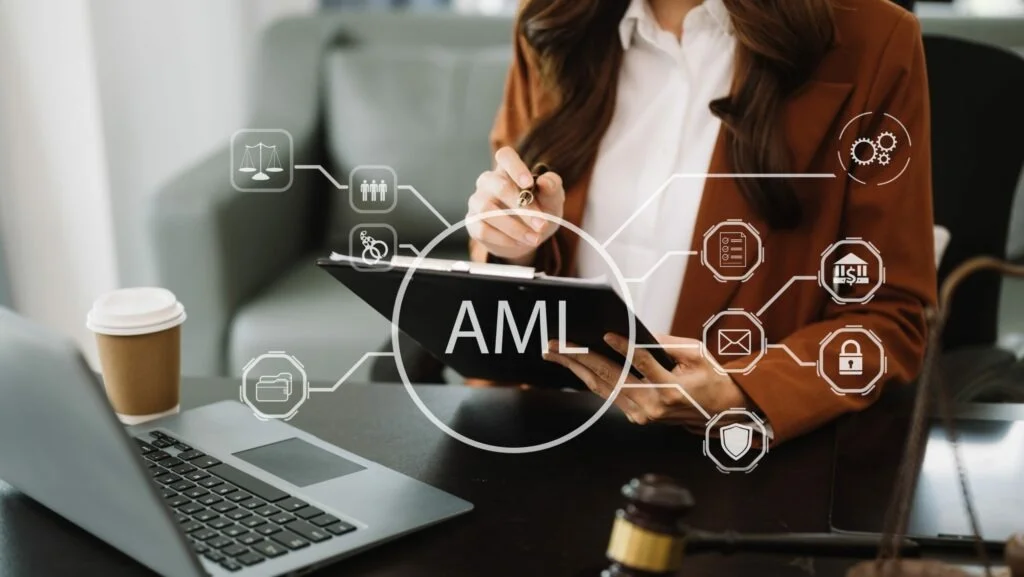
AML Screening
The regulatory landscape and financial crime risks are constantly evolving, making it difficult for financial institutions, fintech platforms, and digital marketplaces to perform their functions. Failure to comply can lead to fines, reputational damage, and operational disruption. Consequently, organizations are beefing up their compliance systems and implementing cutting-edge AML Screening features extending beyond compliance checks.
As a financial risk management tool, AML screening should be regarded not as a compliance obligation, but as a strategic approach for early detection of AML risks and the preservation of confidence in the financial system.
Intelligent AML Screening to enhance compliance
Financial crime prevention has become a key issue for global regulators, who are increasingly calling for proactive measures. In addition to verifying their customers’ identities, institutions are expected to monitor financial activity to identify suspicious activity continuously.
By adopting up-to-date AML Screening solutions that are up to date, businesses can identify sanctioned individuals, politically exposed persons (PEPs), and other high-risk entities at onboarding and throughout the customer lifecycle. This proactive approach helps organizations stay compliant with changing regulatory requirements and minimize the risk of financial crime.
Expert screening features enable compliance teams to swiftly detect risk signs and respond to regulatory requirements more efficiently.
The importance of AML Screening Software in financial operations
Compliance teams are now dealing with high volumes of customers’ data and transaction flows. For organizations with thousands or millions of transactions every day, manual compliance testing is not scalable.
The modern AML Screening software streamlines the verification and screening process by bringing together worldwide watchlists, sanctions lists, and adverse media sources into a single compliance framework. This automation offers the tremendous benefits of greater accuracy and lower operational compliance loads.
In addition to automation, the advanced solutions use machine learning and intelligent matching algorithms to minimize false positives and enable more accurate risk identification. This enables companies to prioritize their resources to look into a genuine threat rather than deal with unnecessary alerts.
AML Transaction Screening for Real-Time Risk Detection
Financial crime involves sophisticated transactional structures and quickly changing transactional patterns. Static screening on entry is not enough to identify potential new risks.
AML transaction screening allows institutions to review financial transactions in real time and detect unusual activity, including those involving high-risk jurisdictions, abnormal transaction patterns, or unusual transfers.
Transaction screening can also be used alongside compliance policies to help organizations identify financial crime indicators before they result in compliance violations.
Transaction Monitoring as a continuous compliance tool
Those risks identified in the screening process are analyzed in the transaction monitoring process. It constantly monitors financial transactions for irregularities and unusual patterns.
Good monitoring mechanisms can identify activities like:
- Quick fund transfers between a wide range of accounts.
- Ensuring transactions are structured to fall below minimum reporting requirements
- Interjurisdictional transfers to and from sanctioned jurisdictions
- Abnormal behavior that doesn’t match a customer’s profile.
Compliance organizations can leverage monitoring tools to integrate with AML screening systems and provide a more holistic compliance ecosystem that identifies risks across the full customer lifecycle.
Establishing a successful AML screening process
Organizations that achieve strong compliance results usually use a well-defined AML Screening process within their business processes.
There are several important components of this process:
- Compliance Check Customer Onboarding to global sanctions & watchlists.
- Periodic re-screening to reflect changes in regulatory information databases
- Transaction monitoring: identifying unusual transactions or those that do not fit the user’s profile.
- Increasing alarms to compliance teams for investigation
A well-structured process guarantees that the screening activities are consistent, auditable, and meet the regulatory requirements.
Providing access to screening that meets Global AML Screening Requirements
Financial crime continues to evolve, and regulators around the world are improving AML screening standards to meet the challenge. Sanctions list screening, continuous monitoring, suspicious activity reporting, and high-risk entity due diligence are frequently involved compliance requirements
Additionally, organizations conducting business across borders need to consider differences in regulations across countries, adding another layer of compliance complexity.
As regulatory requirements evolve, institutions can implement scalable compliance technology to meet their new obligations and continue to have the same screening processes in different markets.
Compliance as a competitive advantage
Investing in modern AML infrastructure is not just about regulatory compliance; it’s about enhancing the organization’s overall capabilities. Compliance structures also help to build trust with partners, regulators, and customers. Multilevel AML (Advanced Multi-layered Analysis) technology enables businesses to expand their operations safely, with transparency and accountability across their financial systems. Financial ecosystems are increasingly digital and expanding globally. Institutions that are focused on intelligent screening and monitoring will be better equipped to manage risk, comply with regulations, and develop future operational resilience.
you may also read nowitstrend.
About the Author